By Baklinski Home Improvement · November 19, 2026
"Dry rot" is what everyone calls it, and the name is a little misleading. The USDA's Wood Handbook is plain about this: serious decay only happens when wood is wet, above roughly 30 percent moisture, and wood that stays air-dry, at about 20 percent or less, won't decay. The crumbly, dry-looking wood we pull out of walls was wet for a long time first. It only looks dry by the time somebody finds it.
So looking for dry rot really means looking for the places water sits. On the houses we work on around Mercer Island, Seattle and Bellevue, two of the most common are under windows and around decks. Here's what those spots look like from the outside, and what we've found once we opened them up.
Why you notice it in winter
The same handbook notes that decay is relatively slow below 50°F. Winter mostly does the wetting. A lot of the damage happens in the milder months, and then a wet November is when a sill finally gives under your thumb or a stain shows up on the drywall. That makes now a good time to look. What you find is the result of water that got in a while ago.
Under a window, start at the bottom corners
Water that gets past a window tends to end up low: the sill, the corners under it, and the framing below. From outside, look for paint bubbling or peeling at the sill and the bottom corners of the trim, caulk that has pulled away at those corners, and a dark or swollen edge on the siding just under the window. Press on the trim with the handle of a screwdriver. Sound wood pushes back. Soft wood doesn't.
From inside, check the drywall under and beside the window for a stain, a tide line, or a spot that feels soft. Paint lifting at the bottom corners of the window return, or a musty smell in that one corner, are worth taking seriously.
What a Mercer Island bay window showed us
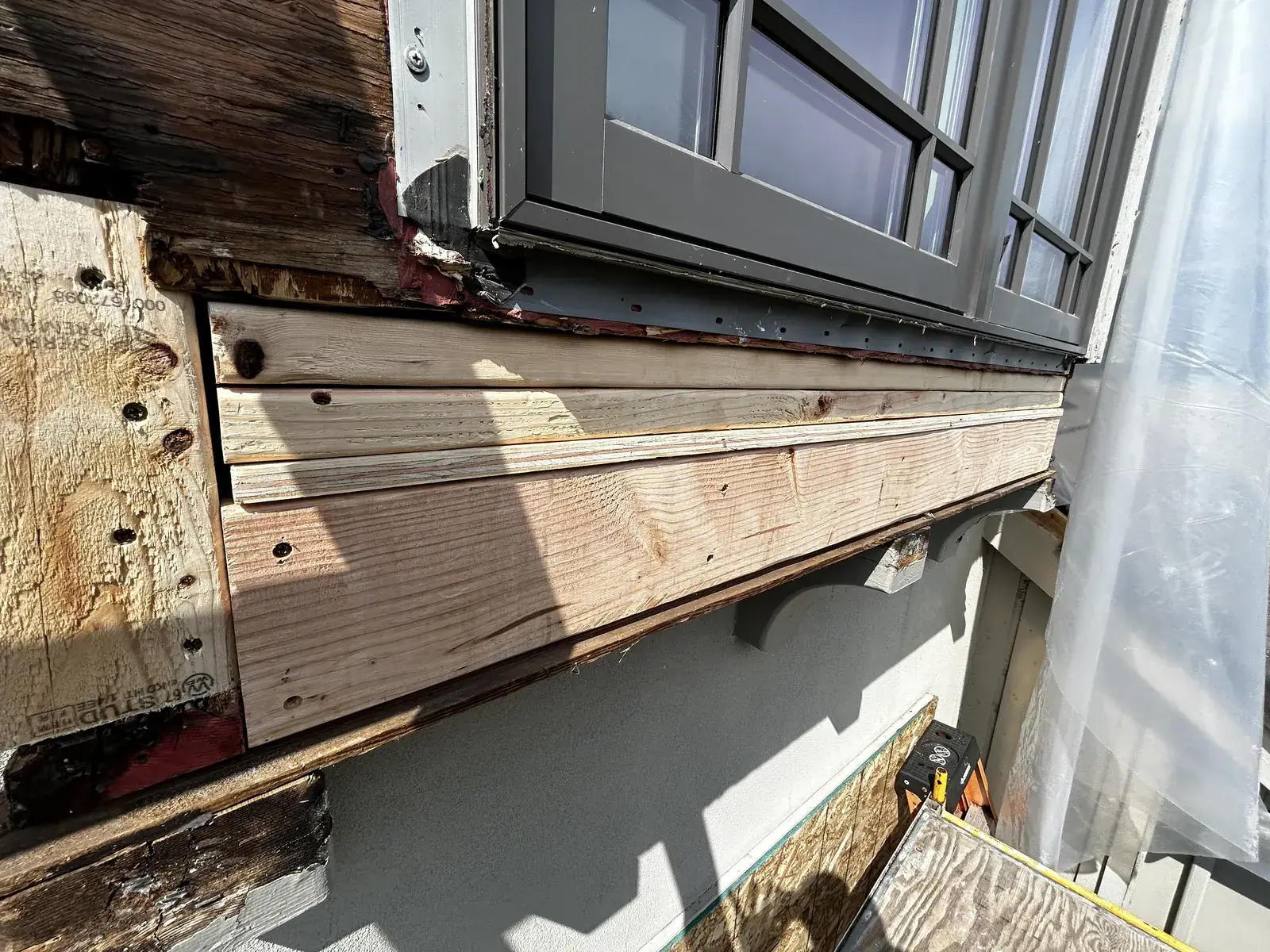
On one Mercer Island job, the homeowner noticed the bump-out under a big view window was starting to rot, and mold was showing. From inside it looked like a drywall patch. Once we opened the wall beside the window, the framing behind it was stained. Outside, the bottom edges of the siding panels had gone soft and brown where they sat on the trim ledge, and the framing under the window had to come out.
That one was a rebuild, not a patch. We took out the damaged frame and the framing that had gone bad, built it back with new lumber, and wrapped the whole bump-out in self-adhered flashing membrane before the new siding went on. Then a new window went in. The full story is in our Mercer Island window restoration.
What we keep relearning: by the time paint bubbles on the outside, what looks like a trim problem has often become a framing problem.
Decks fail at the connections
Deck boards get the attention because you stand on them. The parts that usually go first are where wood meets wood, or wood meets something wet: the ledger where the deck attaches to the house, the tops of joists under the boards, the bottoms of posts, and any place the wood touches soil.
On a Seattle deck we rebuilt, the roof overhang was held up by what looked like a solid 8x8 column. Inside that column was a single vertical 2x4, and there was nothing under it. The joists and beams in that section were rotted through. We reframed everything from that corner to under the stairs in pressure-treated lumber, waterproofed the upper level, and finished it with composite decking and a composite staircase. That job is written up in our Seattle rotting deck repair.
You won't see a hollow column from the yard. You can push a screwdriver into the bottoms of the posts and the joist ends nearest the house, and look up at the ledger for dark staining or rust streaks below the bolts. Also check for a post sitting straight in the dirt, or in a puddle on concrete.
Wood that touches dirt
The International Residential Code, which Washington uses as the base for its residential building code, is clear on this. Wood in contact with the ground has to be pressure-treated for ground contact (section R317.1.2). Siding, sheathing and wall framing within 6 inches of the soil have to be decay-resistant or treated wood (R317.1). Plenty of older houses were built before anyone held to that, or the soil has crept up the wall since.
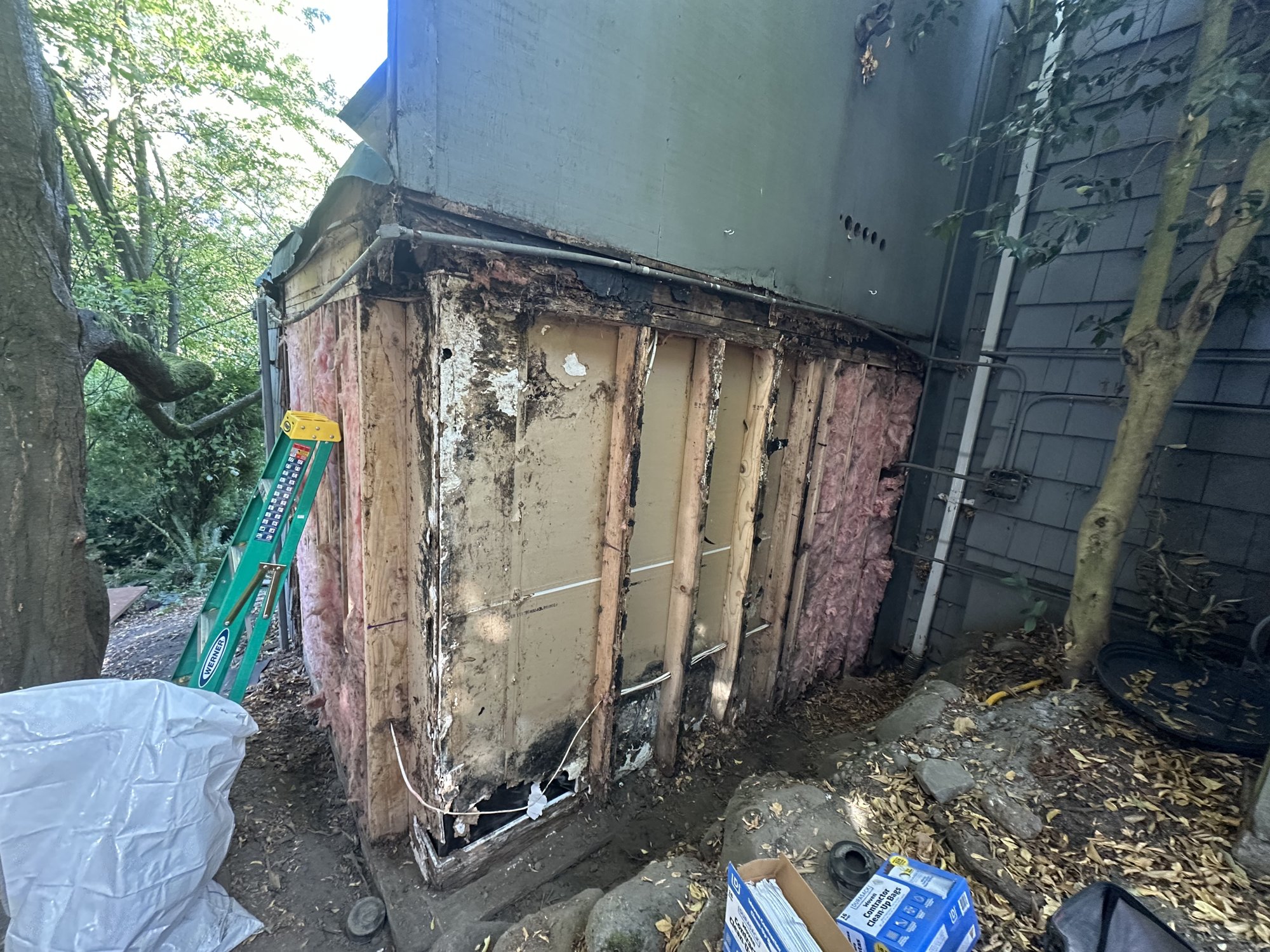
We see what happens. On an entry walk we opened up, the wood frames under the steps had been sitting in the soil, and they came out in pieces. On a Seattle garage, the siding at a back corner was crumbling. Behind it, the whole sill plate had rotted out. We replaced the sill with pressure-treated lumber, reinforced a support beam that had rot in it, and patched in matching siding. That garage corner started as a siding complaint.
The homeowner check is easy. Measure from the soil to the bottom of the siding. If a flower bed or mulch has built up against the wall, pull it back.
When it stops being a handyman job
A small soft spot in a piece of trim can sometimes be cut out and replaced. It's a different job when the screwdriver keeps going, when the soft wood is a post, a beam, a ledger, a sill plate or the framing around a window, when a deck feels bouncy, or when the same spot comes back after you paint it. That's a structural repair conversation. The wood around it needs to be opened up until we reach sound material, and the water source has to be found and fixed, or the new wood goes the same way.
If you want someone to look
If you've found a soft sill, a post you don't trust, or siding that's dark at the bottom edge, call a BHI rep at (206) 681-6634, or visit baklinski.com. We work on houses in Mercer Island, Seattle, Bellevue and Kirkland, and a soft spot is a lot easier to deal with before it reaches the framing.
Scope
Where dry rot starts around windows and decks
Projects
Mercer Island bay window, Seattle deck, Seattle garage
Source
USDA Wood Handbook, ch. 14; IRC R317
Market
Greater Seattle
Every Baklinski project carries a 1-year warranty and direct access to Andrew & Niki, start to finish. We treat your home like our own.