By Baklinski Home Improvement · November 12, 2026
Seattle rain doesn't arrive as one storm you can point at. It settles in. At Seattle-Tacoma International Airport, NOAA's 1991–2020 climate normals put November through February at 21.57 inches of precipitation — a little more than half of the 39.34 inches in a typical year. November is the wettest month, at 6.31 inches.
That water has to go somewhere. On a lot of the houses we work on in Mercer Island, Seattle and Bellevue, "somewhere" is a gutter seam, a window sill, a deck ledger, or the soil piled against the siding. This is the walk-around our crews do when the weather turns. If something feels soft, loose, or wrong, that's a conversation, not a weekend project. Call a BHI rep at (206) 681-6634, or start at our handyman services page.
1. Gutters
Start at the gutters, because that's where the roof tries to hand the water off. Look for sections pulled away from the fascia, sagging spans, and seams that have opened up. From the ground after a rain, you can often see the overflow — a wet stripe on the siding, or a puddle at the same corner every time. A gutter that overflows in the same spot every storm is sending water down the wall and into the soil at the foundation, which is where a lot of the rot we open up later got its start.
2. Downspouts
Check the elbows at the top and the bottom. If the downspout dumps right at the foundation, the water is doing a short lap around the house and coming back. What we look for is a clear run that carries water several feet out, onto a slope that falls away from the house. If a buried drain is tied to the downspout, watch it during a hard rain. Water backing up at the fitting usually means the line is silted or crushed — worth finding now, not in January when the ground is already soaked.
3. Roof edges, fascia and flashing
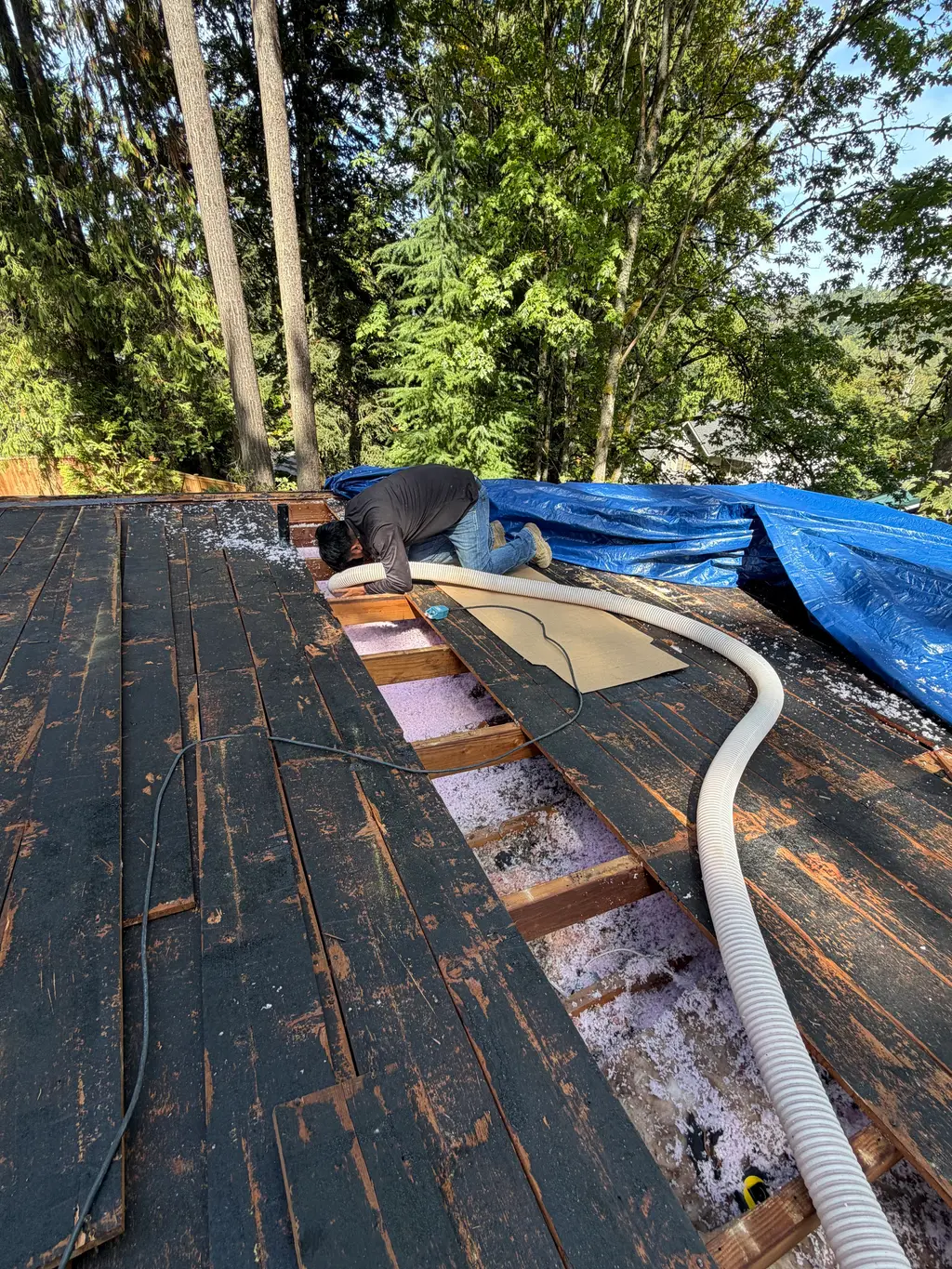
From the yard, look at the roof edge: curled or missing shingles, exposed nail heads, and fascia boards that have gone dark or fuzzy. Pay attention to valleys and to the places a roof meets a wall. Those flashings work hard in a wet winter, and a small gap there can wet the sheathing behind the siding. You don't need to get on the roof; a phone zoom from the yard will show a lot. Soft fascia is not a paint problem. That's water that's already been inside the board.
4. Windows and door trim
Walk every side of the house and look at the caulk where the trim meets the siding, and where the window frame meets the trim. Cracked, shrunk, or missing caulk is a gap water will use. Check the sills for peeling paint, swelling, or a dark line at the bottom — often the first sign of sill rot. A sash that sticks after a wet week is telling you the wood is moving. The same goes for entry doors: weatherstripping that's flat or torn, and a sweep that no longer meets the threshold, will let wind-driven rain in around the frame.
5. Siding and trim
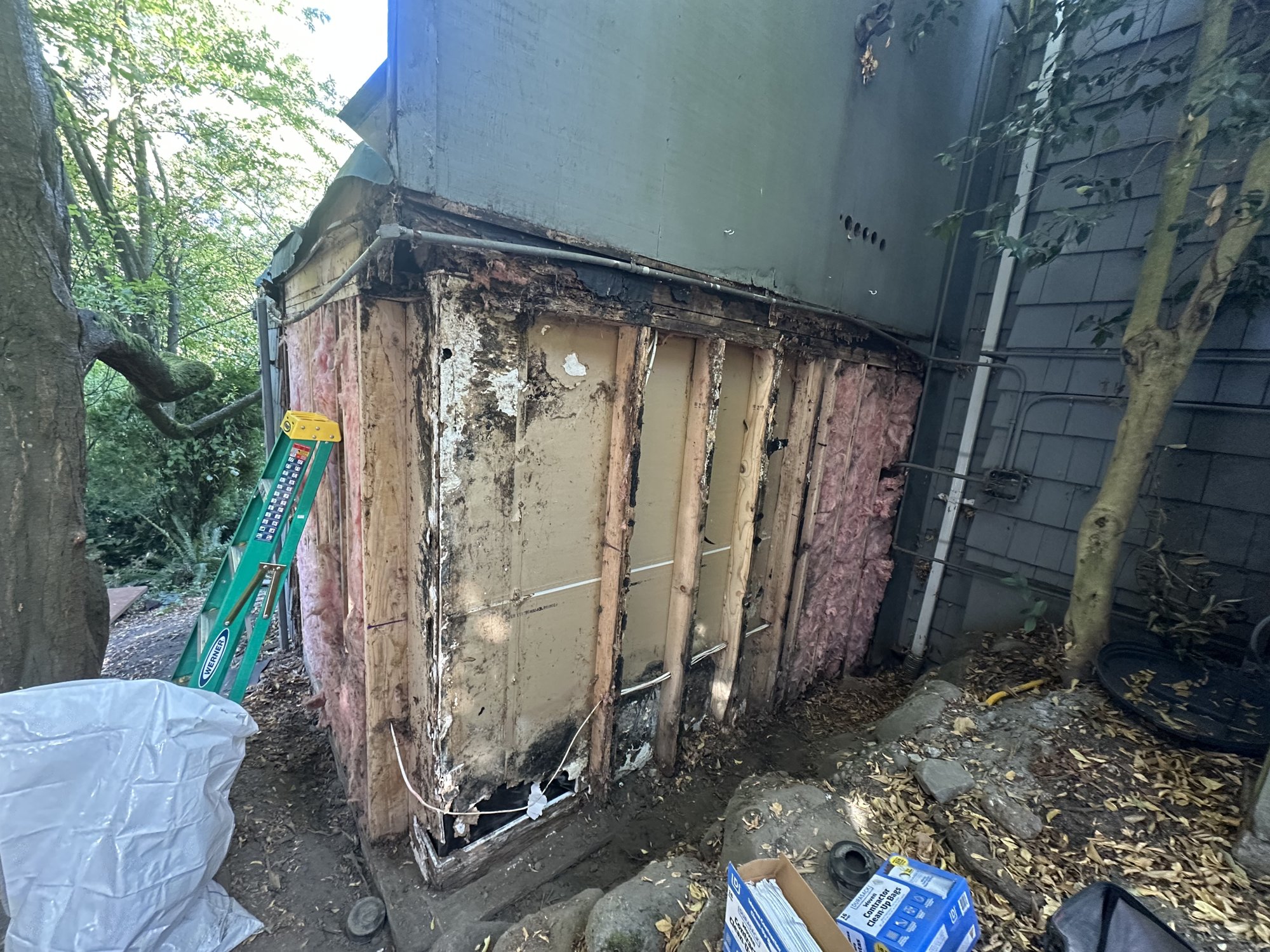
Look low. The first couple of feet of siding, the corner boards, and the trim at the bottom of a wall take the splash from the gutters and the grade. Press gently with a screwdriver handle on any board that looks stained, swollen, or buckled. Healthy wood is firm. Soft wood is a finding. The early signs from outside are bubbling paint, a board that's proud of its neighbors, rusty nail heads in a line. If you find those, stop digging and call about a structural look. Some of that work is in the wall, not just on it.
6. Deck boards, the ledger and the railings
A deck spends the winter wet. Walk it. Boards that spring or feel mushy underfoot, especially near the house and around posts, are the ones to mark. Then look at the ledger — the board that bolts the deck to the house. That's the connection we care about most. Staining, rusted fasteners, or a gap at the ledger flashing is not something to leave until spring. We wrote about a Seattle deck that had already gone past a simple board swap. The honest move is to catch it earlier than that.
7. Attic vents
From the yard, make sure soffit vents aren't painted shut or packed with insulation or nests, and that the ridge or roof vents are clear. An attic that can't breathe holds moisture against the underside of the roof. We covered the simple version of this in An Attic That Finally Breathes: intake at the soffits, exhaust at the ridge, no gadgets required. If you have a safe hatch and a flashlight, look up on a wet day. Heavy condensation on the roof nails, or damp insulation, means the attic is wetter than it should be.
8. The crawl space
If the house has a crawl space, open the hatch and look before you drop in. Standing water, insulation hanging off the floor joists, and a sharp musty smell are the usual tells. Check that the plastic vapor barrier on the soil is still in place and lapped, not shredded or pulled aside. Look at the rim joist and the bottoms of posts. Water at the stem wall after a rain is a drainage issue at the exterior, not a question of running a fan for a weekend.
9. The grade around the foundation
Walk the perimeter. Soil, mulch and gravel should fall away from the house, not toward it. Flower beds built up against the siding, and downspouts that have washed a hollow right at the foundation, are two of the most common things we find. If the grade is against the siding or covering the top of the foundation, pull it back now, while you can still work in the yard.
10. Walk the inside after the next hard rain
The last check only works after a real rain, not on a dry Tuesday. Look at the ceilings under bathrooms and at the top-floor corners under the roof edge. Feel the drywall at the window reveals. Check the basement or lower level along the exterior walls, and the closet that always smells a little off. A faint stain that appears in the same place every winter is a map — take a photo, note the date, and keep it. If the stain is growing, or you can feel damp, that's the time to get someone over.
If you want a second set of eyes
Most of this list is looking and touching, not tearing things open. If something doesn't sit right — a soft sill, a ledger you don't trust, a crawl space with water in it — call a BHI rep at (206) 681-6634, or visit baklinski.com. We work on houses in Mercer Island, Seattle, Bellevue and Kirkland, and we'd rather look at a small problem in November than a wet wall in January.
Scope
Winter rain walk-around for Seattle-area houses
Season
November through January
Rainfall
21.57 in. Nov-Feb at Sea-Tac (NOAA 1991-2020)
Market
Greater Seattle
Every Baklinski project carries a 1-year warranty and direct access to Andrew & Niki, start to finish. We treat your home like our own.